fbpx
North Central State College North Central State College

Other News & Events

Scholarship Application

North Central State College Foundation Scholarships application open

  • Who may apply? Those who will be regularly enrolled students at the College during the 2026-2027 academic year (fall 2026 spring 2026-2027). A regularly enrolled student is one who has graduated from high school (or received a GED) and is seeking to earn an NC State degree or aid-eligible certificate.
  • Deadline to apply: March 1, 2026
  • Those awarded a scholarship will be notified by mid April.
  • All applicants must file a 2026-2027 FAFSA by March 1, 2026.  NC State’s FAFSA code is 005313
  • Incomplete applications will not be considered. You will not be notified if your application is incomplete.
  • Most scholarships carry stipulations (e.g., major, GPA, level of enrollment, place of residence, year-in-college, etc.)
  • Scholarship proceeds will be credited to recipients’ fiscal accounts at the College to help pay tuition expenses. No cash payments will be made to students from scholarship funds.

Application is live from February 1, 2026-March 1, 2026

Access the application here from February 1, 2026-March 1, 2026

For a complete list of scholarships available visit the North Central State College Foundation

Students Develop Groundbreaking “Mechanical Brain” to Advance Crash Safety Research

A team of engineering students at North Central State College is pushing the boundaries of crash safety research with a first-of-its-kind project: a 3D-printed “mechanical brain” designed to mimic how the human brain responds during a crash.

The innovative work led by Bachelor of Science in Mechanical Engineering Technology (BASMET) students Jakob Fishel, Mark Depinet, Aiden Payne, and Kevin Romero has evolved over several years into a system that could one day help predict and prevent traumatic brain injuries in car accidents and even contact sports.

“This is creating a first-of-its-kind surrogate brain inside a 3D-printed skull,” Jakob explained.  “The goal is to eventually link it to a measurement system that can help predict injuries.”

The project builds on earlier student research that used simplified materials to simulate a brain.  Over time, the design has grown more complex and more realistic.

“The BASMET class before us was simulating a sheep brain,” Mark said. “It kind of evolved from that.”

Today’s version features a brain made from thermoplastic polyurethane (TPU), a flexible 3D-printed material that better mimics the properties of real brain tissue.  The model includes detailed structural features, such as ridges that allow researchers to track movement using ultrasound technology.

“It’s easier to see on the ultrasound machine,” Aiden said. “The different elevations make it easier to track how the brain moves.”

The brain sits inside a carefully engineered 3D-printed skull, which has gone through multiple design iterations.  Earlier versions were bulky and difficult to assemble, but the current design simplifies the process while maintaining accuracy.

“We went from a three-piece assembly to a two-piece design,” Aiden said. “It’s more efficient and easier to work with, even though it’s still a tight fit.”

The project has gained valuable support from industry and research partners.  The team collaborated with Humanetics, a leading manufacturer of anthropomorphic test devices (also commonly known as crash test dummies) based in nearby Huron, Ohio, which provided mentorship, resources, and 3D printing assistance.

“They helped mentor us through the initial phases,” Mark said. “Having the real-world experience and input made a huge difference.”

The students also worked closely with researchers at the Vehicle Research and Test Center (VRTC), part of the National Highway Traffic Safety Administration (NHTSA). VRTC experts provided guidance on design improvements and testing methods, including the use of ultrasound tracking.

“They helped us correlate our data with human testing data,” Mark said. “They also suggested features like the brain ridges to improve measurement accuracy.”

Testing took place at The Ohio State University’s biomechanical lab, where the device was subjected to rotational forces like those experienced in car crashes.  Sensors captured how the brain model moved inside the skull during impact. “The best way to think about it is like your head jerking forward in a car crash,” Aiden explained.

According to preliminary observations, the mechanical brain’s movement closely matches that of human brain specimens in similar tests, which is an encouraging sign for the project’s future.

Instructor Mike Beebe said the project marks a significant milestone. “This team has been the first to create a mechanical brain in a crash test dummy head that reacts like a human brain in rotational testing,” Beebe said.  “It has the potential to measure brain injury in the future.” Ultimately, the students hope their work will contribute to safer vehicle design and improved protective equipment.

“The final goal is to use this in real-world applications,” Jakob said. “Whether it’s making cars safer or improving helmets in sports like football, we want to reduce concussions and save lives.”

Beyond the technical achievements, the project provided valuable hands-on experience with the students involved. “My biggest takeaway is learning how to work as a team,” Aiden said. “We had to figure out each step together and make sure everything came together.” The project is also opening doors for future opportunities.  Jakob plans to pursue a master’s degree in biomechanics at The Ohio State University and hopes to continue developing the research. “I’d love to take this project further,” he said.

Meanwhile, other team members are preparing to enter the workforce, bringing them real-world engineering experience shaped by the project. With a strong foundation now in place, the team hopes future students will continue refining the technology.  “We’ve built something that others can take and run with,” Aiden said. “There’s a lot more potential here.”

As research continues, this student-driven innovation could play a key role in better understanding brain injuries, and ultimately in helping prevent them.


College-Now student named to All-Ohio Academic First Team

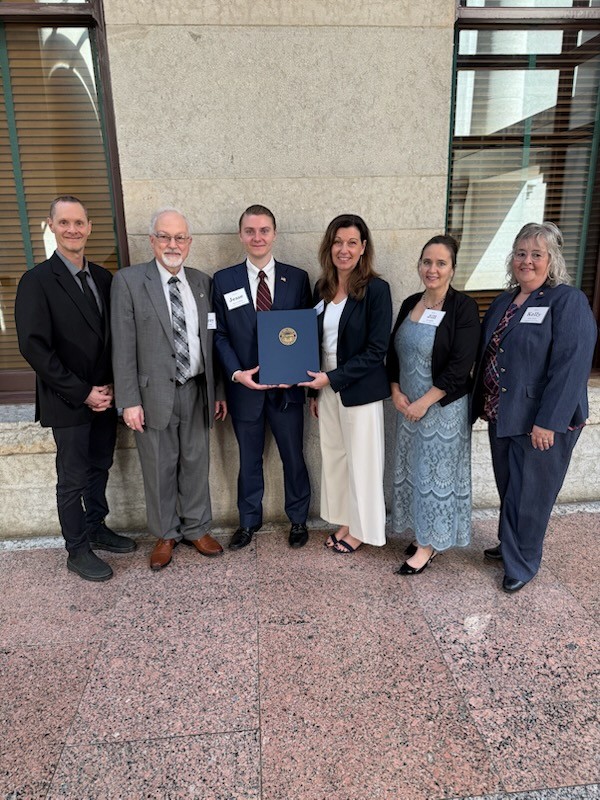
Jesse Halfhill holds in award surrounded by his family, college representatives, and state representatives.

The Ohio Association of Community Colleges has recognized North Central State College student Jesse Halfhill as one of the top-performing students among Ohio’s 23 community colleges.  The All-Ohio Academic First Team celebrates academic achievement, with honorees receiving a $1,000 scholarship and special recognition for their success.

At just 18 years old, Halfhill has already distinguished himself as a student leader, community servant, and driven young professional with a clear vision for the future.  As a participant in the College-NOW Business Administration program at North Central State College in partnership with Pioneer Career and Technology Center, he has transformed a single decision during high school into a defining journey, one marked by academic excellence, leadership, and purpose.


Halfhill’s story began during his junior year of high school when he enrolled in College-NOW, a program designed to give students a head start on their college education.  The program is a two-year, full-time program allowing high school juniors and seniors to earn an Associate of Arts in Business Administration degree while simultaneously completing their high school diploma.

During his senior year, Halfhill expanded his leadership roles significantly. He joined the Honors Council Advisory Board and accepted the position of Chapter President of Phi Theta Kappa International Honor Society, taking on responsibilities that would challenge him to lead, collaborate, and serve at a higher level, all while still completing his high school education.

Halfhill approached the experience with intention.

“If I wanted to become great, I knew I had to dedicate myself to working, serving, and studying harder than I ever had before,” he said.

That mindset quickly propelled him beyond the basics.  What started as a way to get ahead academically soon evolved into a personal mission, one centered on growth, challenge, and contribution.  Halfhill began to see education not just as a requirement but as a tool to expand his understanding of the world and his role within it.

“These experiences have pushed me to think critically, ask deeper questions, and engage with complex ideas; skills that would continue to shape my academic path,” he explained.

But for Halfhill, growth wasn’t limited to the classroom.

As he became more involved in the Honors College, he also began connecting with local businesses and community leaders.  It was through these interactions that he recognized the profound impact individuals can have when they invest in their communities.  Inspired by that realization, he made a conscious decision to follow that example.

His academic achievements matched his leadership efforts.  Halfhill consistently earned a place on the Dean’s List, yet even with a demanding academic schedule, he remained deeply committed to serving.

Throughout the week, Halfhill stays actively engaged in the community, volunteering his time and supporting local seniors, assisting those in need, and tutoring fellow students while gaining a deeper understanding of local leadership and service.

For Halfhill, these efforts weren’t about adding activities to a resume; they were about living out a purpose.

“All of these were opportunities I took advantage of, not only to grow myself, but to give back to the community that made them possible,” he said.

That sense of purpose has become the foundation of his future goals.

Through his experiences at North Central State College, Halfhill discovered what he describes as a calling “to create,” to build something meaningful that extends beyond personal success.  He sees education as a springboard, not a destination, and is determined to use it to make a lasting impact.

In May, Halfhill will graduate from North Central with an Associate of Arts in Business Administration, and in the fall, he will take the next step in his academic career at Ashland University, where he plans to pursue a double major in Business Analytics and Finance.  In addition, he has been accepted into the Ashbrook Program, where he will study Political Economy, further expanding his understanding of the systems that shape business, government, and society.

Halfhill’s long-term vision is both ambitious and deeply rooted in community.  He hopes to begin his career on Wall Street, gaining experience and expertise needed to eventually return to North Central Ohio and establish the region’s first venture capital investment banking firm in Mansfield.

“I won’t simply be adding credentials to my resume,” Halfhill said.  “I will be able to create, and I will be creating for a purpose; to better the community around me.”

His leadership and perspective have already earned him recognition.  Halfhill was recently invited to speak at this year’s North Central Ohio Hall of Excellence, where he shared his story with community leaders, emphasizing the importance of opportunity, service, and the responsibility to give back.

Standing before that audience, he made it clear that his success is not his alone; it is the result of a community that invests in its people and creates pathways for growth.

For Halfhill, the message is simple but powerful: when communities commit to developing opportunities, and individuals commit to pursuing them fully, meaningful change becomes possible.

Driven Beyond Limits

For Jillian Nicholson, college didn’t begin after high school, it began during it.

While many students spend their high school years thinking about what comes next, Jillian made the decision to take action early. Through North Central State College’s College Credit Plus (CCP) program, Jillian began the CCP Business Pathway. That journey led her into the Business Management AAB program, where she continued to challenge herself, push her limits, and ultimately transform her future. Jillian started her CCP classes at her high school and completed the rest of her classes online.

“At first, I wasn’t sure if I could handle college classes while still in high school,” Jillian said. “It felt like a big step.”

That uncertainty didn’t last long. Jillian enrolled in her first course with a mix of nerves and determination.  Stepping into a college-level classroom was different from anything she had experienced before.  The expectations were higher, the pace was faster, and the responsibility was entirely her own.

But instead of being overwhelmed, she rose to the challenge. “Once I got started, I realized I was capable of more than I thought,” she said. “It pushed me to stay focused and take my education seriously.”

What began as a single course quickly grew into a clear goal.  Jillian committed herself to the dual enrollment pathway, balancing her high school classes with an increasing number of college credits. She learned how to manage her time, stay organized, and maintain discipline; skills that many students don’t develop until much later.

Her days were full. Between attending high school, completing college assignments, and studying for exams, Jillian had to stay motivated and consistent.  There were moments when the workload felt heavy, but she stayed focused on the bigger picture.

“I knew it would be worth it in the end,” Jillian said.  That focus paid off.

By her senior year, Jillian had accomplished something extraordinary.  Through her dedication to dual enrollment at North Central State College, she wasn’t just preparing to graduate high school; she was preparing to graduate with her associate degree as well.

“It felt amazing to see everything come together,” she said. “All the hard work, all the time I put in, it finally meant something bigger.”

Graduating with both a high school diploma and an associate degree will give Jillian a powerful head start.  While many of her peers were just beginning their college journeys, she had already completed two years of higher education.

The benefits go beyond academics.  By earning her associate degree early, Jillian has saved significant time and money, allowing her to move forward with greater flexibility and confidence. Whether she continues her education or enters the workforce, she does so with a strong foundation already in place.  More importantly, the experience changed how she sees herself.

“I am a lot more confident now,” Jillian said.  “Taking college in high school showed me that I can handle challenges and succeed.”  Her experience also gave her a clearer sense of direction.  Through her coursework, she was able to explore her interests and begin shaping her future goals, something many students are still figuring out after high school.

Jillian credits her success to her willingness to take that first step, even when it felt uncertain.  “It can be intimidating at first,” she said.  “But once you start, you realize you’re capable.  I would definitely recommend it to other students.”

While her mom, Tara, remained a supportive presence throughout her college experience, it was Jillian’s drive, commitment, and perseverance that made this achievement possible. “She took ownership of her education,” Tara says proudly.  “She made her choice and is achieving her goals.  That’s what sets her apart.”

Today, Jillian’s story stands as a powerful example of what students can achieve through dual enrollment at North Central State College.  It’s not just about earning credits early; it’s about building confidence, gaining momentum, and creating opportunities before graduating high school.

For Jillian, choosing dual enrollment wasn’t just a smart decision, it was a life-changing one.


Transformation Through Determination

At 35, Tyson Barton wears many hats: husband, father of three boys, full-time employee, youth mentor, coach, and community volunteer.  Now he can add another title to the list: college student. Barton, who lives in Bucyrus with his wife of 12 years and their children, returned to school at North Central State College after years of putting the idea on hold.

“I’d always talked about going back to school,” Barton said. “But it was always just talk.  I never actually sat down and figured out how to do it.” Before returning to college, Barton spent years working in manufacturing, including at General Electric, before the plant closed.  Like many working adults, he found himself repeatedly missing out on job opportunities and promotions because he lacked the necessary credentials.

“As a husband and a father of three, I knew something had to change,” he said. But Burton wanted to prove something to himself first.

Balancing family life, work, coaching, mentoring students at Bucyrus elementary, serving on a board at the YMCA, and caring for a lively household that includes four dogs, three cats, and eight chickens already keeps him busy. Before enrolling in college, Burton set a personal challenge: losing 100 pounds.

“If I could dedicate the time, discipline, and energy to losing that much weight, I thought it would prove to myself that I could handle school along with everything else life throws at me,” he said. He succeeded, losing more than 100 pounds and gaining the confidence to take the next step.

When Barton finally decided to return to school, the process happened faster than he expected. After sending a quick text expressing interest in enrolling, he was invited to stop by the Crawford Success Center. “I walked into the office and signed up that day,” Barton said. “I didn’t even call my wife first.  I called her after and told her, ‘I start school in August.”

That moment marked the beginning of a new chapter. Today, Barton works full-time at Shoulder Works in Bucyrus while attending classes through North Central State College.  Despite his packed schedule, he has thrived academically.

He is currently on track to graduate in May with his associate degree in accounting as well as a 4.0 GPA. Barton credits much of his success to the support he received through the Crawford Success Center, which helps guide students through enrollment, resources, and academic support. “The Success Center showed me that I can be a positive role model, not just for my kids, but for the young people I coach and mentor,” Barton said.

Barton says his journey has reinforced an important lesson: meaningful change is possible with the right support and opportunities. “I’m proud of how far I’ve come,” he said.  “Places like the Crawford Success Center make a real difference for people who are trying to improve their lives and build a better future for their families.”

For Barton, returning to college wasn’t just about advancing his career; it was about setting an example.  And now he’s doing exactly that.

North Central State College receives national Leah Meyer Austin Award for student success and community impact

Dr Diab receiving the Leah Austin Meyer Award in Portland, Ore.Mansfield, Ohio — North Central State College (NCSC) has been named the recipient of the 2026 Leah Meyer Austin Award, the highest honor conferred by Achieving the Dream (ATD), a national organization committed to advancing community colleges as engines of opportunity, belonging, and economic mobility. The award comes with a $100,000 prize.

Presented annually, the Leah Meyer Austin Award recognizes a college in the ATD Network that exemplifies the highest levels of performance across access, momentum, completion and post-completion outcomes that align with the organization’s Community Vibrancy Framework — a comprehensive model that defines what it takes for colleges to drive student success, economic mobility, and community prosperity. Award recipients show sustained and measurable impact on key student success metrics that lead to strong completion and post-completion outcomes that advance economic mobility, with institutional practices around seven capacities that are deeply embedded in culture and planning.

The award was announced at ATD’s annual DREAM conference in Portland, Oregon, which convened community college leaders, faculty, staff, and higher education partners from across the country and around the world.

“This award is the result of countless hours of effort by the employees of North Central State College,” stated Dr. Dorey Diab, President of NC State. “We are honored to receive this award and are gratified by the recognition of the numerous benefits to our students and graduates over more than a decade. We’ve worked to control costs of a college education, shorten the time required to succeed and perhaps most importantly, align our graduate outcomes to the needs of our employers, who provide ever increasing wages that exceed the statewide average for Ohio. We’re keeping more talented workers close to home and helping them build great careers and rewarding lives for a more prosperous community. Thank you, Achieving the Dream, for this

wonderful recognition and award. As it is a journey, and never a destination, we will continue our path to change lives for better futures.”

North Central State College serves north-central Ohio and offers associate degrees, certificates, and bachelor’s programs in high-demand fields including health sciences, engineering technology, business, and public service. A longtime member of the Achieving the Dream Network, NCSC earned Leader College status in 2009 and Leader College of Distinction status in 2018.

Guided by a commitment to evidence-based improvement, the college has implemented integrated, student-centered reforms designed to improve momentum, affordability, and completion. These efforts include a strengthened advising model that combines proactive case management, early alert systems, and close collaboration between professional advisors and faculty.

Affordability has been a central priority. Through a combination of institutional and state scholarships, a self-funded Promise-style program, and expanded adoption of open educational resources, NCSC has reduced financial barriers for students. Student loan usage declined from 62% in 2015 to 27% in 2023, and today 25% of courses are textbook-free, helping students persist and progress with fewer financial constraints.

To better support students balancing work, family, and education, NCSC expanded flexible learning options, including online offerings and compressed academic terms. Nearly 50% of courses now use shortened formats, and per-capita credit hours attempted and completed recently reached a five-year high.

These reforms have produced strong, measurable outcomes. Between 2014 and 2021, fall-to-fall retention increased by 22 percentage points, and the college’s completion rate rose by 27 percentage points.

As part of its broader commitment to student and community prosperity, NCSC has embraced Achieving the Dream’s Community Vibrancy Framework, aligning academic programs with regional workforce needs and expanding stackable credentials, certificates, and bachelor’s pathways that lead to family-sustaining wages. Median wages for graduates increased from$28,604 in 2018 to $42,792 in 2024, reaching 98% of the regional median wage.

“North Central State College exemplifies what is possible when a college approaches its work with courage, discipline, and an unwavering focus on students and community,” said Achieving the Dream President and CEO Dr. Karen A. Stout. “The college has translated data-informed decision-making and deep engagement with partners into lasting institutional change, improved student outcomes, and meaningful economic mobility. We are proud to recognize North Central State College for the impact it has achieved — and continues to achieve — for its students and region.”

The Leah Meyer Austin Award was established in 2008 and is named in honor of Leah Meyer Austin, whose visionary leadership helped shape Achieving the Dream’s mission and impact nationwide. North Central State College is the 25th ATD Network college to receive the award.

From Brazil to Mansfield: Joao Oswalt Da Silva Pursues His Dream at North Central State College

When Joao Oswalt Da Silva first enrolled at North Central State College, his classroom wasn’t always in Mansfield, Ohio.  In fact, many of his courses were completed thousands of miles away, in Brazil.  Yet despite the distance, Joao found a strong academic connection through North Central’s flexible learning options and supportive environment, one that is helping him move closer to his long-term goal of becoming a physical therapist.

Joao has spent much of his life balancing international experiences with academic ambition. Having lived some of his life in Ohio, Joao still visits often.  He was able to stop by the campus during winter break and loved seeing all of the snow here in Ohio.

Joao’s goal is to become a physical therapist

That clear sense of purpose has guided his academic decisions and kept him motivated, even while taking classes online from another country.  Through North Central State College, Joao has completed nearly ten courses fully online, an experience he describes as both convenient and empowering.

“One of the great things about North Central is how many courses you can take online,” he said. “I’ve done a lot of them, even while I was outside the U.S.”

This flexibility has allowed Joao to stay on track academically.  Online courses gave him access to high-quality instruction without sacrificing progress toward his degree, something that has become increasingly important for students balancing complex schedules or unique life circumstances.

Joao’s academic path is carefully structured.  He credits help from his advisor, Kendell White, for keeping him on track. “She was the first person I met with at the college,” he says appreciatively.  “She has been a huge help the entire time.”

His long-term plan includes earning a bachelor’s degree, followed by a doctorate in physical therapy.  Right now, he is focusing on biology and chemistry to prepare for the next stage of his education.

Those science courses are a critical part of his plan, and Joao has worked closely with advisors to ensure he meets prerequisites for future programs.  Faculty and staff at North Central State College have taken notice of Joao’s work ethic.  He has earned praise for his performance in online courses and for his commitment to his studies.

Joao is also a part of the North Central State College Honors program.  He presented his Honors project on Breaking Barriers: Comparing Physical Therapy Terminology Between English and Portuguese during the fall semester presentation via Zoom from Brazil. The objective of his project was to compare Portuguese and English terminology used in physical therapy.  Joao was able to shadow Maria Rita, a physical therapist with 19 years of experience at Jose Melo Laboratorio in Itacaré, Bahia, Brazil.

Focus and commitment are key to Joao’s success

For Joao, North Central is providing more than just coursework.  It offers flexibility, encouragement, and a foundation for future success.  Whether learning from Mansfield or from abroad, he feels supported in his pursuit of a demanding and rewarding career.

As he continues to work toward graduation and prepares for the next phase of his education, Joao’s story reflects the opportunities available at North Central State College, especially for motivated students who are willing to work hard, think ahead, and take advantage of flexible learning options.

His journey is a reminder that no matter where students are located, North Central State College is committed to helping them stay connected, move forward, and build a pathway toward their goals.

Psychology Degree Course Benefits

Psychology Courses

PSYC-1010: Introduction to Psychology

This class introduces you to how people think, feel, and behave. You will learn about the brain and body, memory, learning, emotions, personality, and social interactions. You’ll also explore mental health, motivation, and human development throughout life. The course shows how psychologists study people and how their findings can be applied to real situations.

How it helps in daily life:

  • Helps you understand why people think, act, and feel the way they do

  • Gives you tools to work better with others at school, work, or home

  • Helps you recognize and respect differences in people from different backgrounds

  • Shows you how to make thoughtful decisions using information and evidence

  • Teaches how to notice and respond to mental health needs in yourself and others

PSYC-2050: Psychopathology

This class explores mental health disorders and how they are diagnosed and treated. You will learn about conditions like anxiety, depression, personality disorders, addictions, and psychotic disorders. The course covers causes, symptoms, and treatments, using research and ethical guidelines to understand psychological illness.

How it helps in daily life:

  • Helps you understand mental health issues in yourself and others

  • Teaches skills for recognizing symptoms and knowing when to seek help

  • Improves empathy and communication with people facing psychological challenges

  • Provides knowledge useful for careers in counseling, healthcare, social work, or education

  • Teaches critical thinking for separating myths about mental illness from scientific evidence

COMM-1010: Speech

This class teaches you how to speak confidently in front of others. You will learn how to give different types of speeches, like informative talks, persuasive presentations, impromptu speeches, and group projects. You’ll also practice using gestures, eye contact, and visual aids to make your message clear.

How it helps in daily life:

  • Helps you feel more confident speaking in class, at work, or in meetings

  • Teaches you how to explain your ideas clearly so others understand you

  • Shows you how to listen carefully and respond thoughtfully

  • Helps you work well with different kinds of people and understand their perspectives

  • Gives you skills to persuade others, share your opinion, or present ideas professionally

ENGL-1010: English Composition I

This class teaches you how to read and write clearly. You will read nonfiction texts and practice summarizing, analyzing, and writing essays. You’ll also learn how to research a topic and write a well-organized argument. The class helps you plan, draft, and revise your writing so it makes sense and is easy to understand.

How it helps in daily life:

  • Helps you explain your ideas clearly in emails, reports, or school assignments

  • Teaches you how to read carefully and understand important information

  • Shows you how to plan and organize your thoughts before writing or speaking

  • Gives you skills to research topics and back up your opinions with facts

  • Helps you communicate professionally in work or personal projects

STAT-1010: Probability and Statistics

This class teaches you how to understand and work with data. You will learn how to collect information, organize it in charts and tables, and use basic math to see patterns and trends. The course also covers probability, statistics, and ways to make conclusions from data.

How it helps in daily life:

  • Helps you make sense of numbers in news, surveys, and reports

  • Teaches you how to organize and analyze information to make better decisions

  • Shows you how to spot trends and patterns in data, which is useful at work or in school projects

  • Helps you understand the likelihood of events, which is useful for planning and problem-solving

  • Gives you skills to interpret graphs, charts, and statistics you see every day

HUMA-1010: Introduction to the Humanities

This class introduces you to different forms of art, including painting, literature, drama, film, photography, and sculpture. You will learn how to understand, analyze, and talk about works of art. The course also explores different ways people think about and interpret art, and you’ll go on field trips to experience art in real life.

How it helps in daily life:

  • Helps you appreciate and enjoy art in everyday life, like movies, books, and museums

  • Teaches you how to think critically and express your opinions clearly

  • Improves your ability to understand different cultures and perspectives

  • Builds skills to discuss and evaluate ideas, which is useful in work, school, and social settings

  • Encourages creativity and problem-solving through exposure to art and different viewpoints

MUSC-1010: Music Appreciation

This class teaches you how to listen to and understand music. You will learn about different musical styles, instruments, and ensembles, and explore how music has changed over time. You’ll also learn the words and ideas musicians use to talk about music and how to describe and respond to performances.

How it helps in daily life:

  • Helps you enjoy music more by understanding what you hear

  • Teaches you how to pay attention and notice details, a skill useful in school and work

  • Gives you the words and knowledge to talk about music confidently with others

  • Helps you appreciate different cultures and historical periods through their music

  • Improves focus, critical thinking, and listening skills that apply to everyday life

POLT-1010: American National Government

This class teaches you how the U.S. government works, including its people, values, rules, and institutions. You will learn about the three main branches of government, how laws are made, and how political systems like elections, parties, and the media influence decisions. The course also covers civil rights, social justice, and both domestic and foreign policy.

How it helps in daily life:

  • Helps you understand how laws and government decisions affect your life

  • Teaches you how to participate in your community, like voting or volunteering

  • Gives you the tools to follow and understand news and political discussions

  • Helps you think critically about policies and issues that affect society

  • Prepares you for careers in government, public service, or any job that requires understanding rules and systems

ENGL-1030: English Composition II

This class teaches you how to write clear, well-organized arguments and research papers. You will read issue-based texts, plan and research your ideas, use sources correctly, and learn how to persuade readers with evidence. The course also helps you revise your writing so it is strong, clear, and professional.

How it helps in daily life:

  • Teaches you how to explain your ideas clearly in school, work, or personal projects

  • Shows you how to find and use trustworthy information to support your opinions

  • Helps you organize your thoughts and write in a way that makes sense to others

  • Builds skills in critical thinking and problem-solving

  • Prepares you for writing reports, proposals, or persuasive messages in professional or personal settings

PHIL-1010: Western Philosophy

This class introduces the major ideas and thinkers that have shaped Western culture, from ancient Greece to modern times. You will learn about famous philosophers and their ideas, how people have thought about ethics, society, and the meaning of life, and how these ideas influence the world today.

How it helps in daily life:

  • Helps you think clearly and reason through problems in everyday life

  • Teaches you how to see situations from different points of view

  • Improves your ability to discuss ideas and make thoughtful decisions

  • Helps you understand the history of ideas that influence culture, law, and society

  • Builds critical thinking skills useful in school, work, and personal decisions

PSYC-2010: Human Growth & Development

This class teaches how people grow and change from birth to old age. You will learn about physical, emotional, social, and thinking development at different stages of life, and how researchers study these changes. The course also looks at culture, environment, and family influences on growth.

How it helps in daily life:

  • Helps you understand yourself and the people around you at different ages

  • Teaches skills for parenting, teaching, or working with people of all ages

  • Helps you recognize healthy growth and development, as well as challenges

  • Shows how research can help guide decisions about education, work, and relationships

  • Improves communication and empathy with children, adults, and older adults

PSYC-2030: Child Psychology

This class teaches how children grow and develop physically, emotionally, socially, and mentally. You will learn how culture, family, and environment influence childhood development and how researchers study children using science.

How it helps in daily life:

  • Helps you understand children’s behavior and needs at different ages

  • Teaches skills useful for parenting, teaching, coaching, or childcare

  • Shows how to recognize healthy development and address challenges early

  • Helps you make better decisions when supporting or guiding children

  • Improves communication, patience, and empathy with children in everyday life

SOCY-1010: Introduction to Sociology

This class teaches how society works and how people interact within it. You will learn about culture, social groups, families, schools, government, and other social institutions. The course also explores social differences, such as race, gender, class, and how rules, laws, and norms shape behavior.

How it helps in daily life:

  • Helps you understand why people behave the way they do in your community, school, or workplace

  • Teaches you how to work with people from different backgrounds and cultures

  • Improves your ability to think critically about social issues and current events

  • Gives you skills to analyze problems in society, like inequality or crime, and think about solutions

  • Prepares you for jobs in social services, education, healthcare, and other fields where understanding people and society is important

BIOL-1230: Biology I

This class introduces the basics of biology, including cells, genetics, energy, and how living things grow and survive. You will learn the scientific method, study cells and their parts, explore DNA and heredity, and understand how energy moves through living systems. Labs will give hands-on experience with experiments and observations.

How it helps in daily life:

  • Helps you understand how your body and other living things work

  • Teaches you how to think like a scientist and solve problems using evidence

  • Gives you knowledge about health, genetics, and biotechnology that can guide personal choices

  • Improves critical thinking for reading and understanding news about science and the environment

  • Prepares you for careers in healthcare, research, education, and other science-related fields

HIST-1010: American History I

This class explores the history of the United States from 1600 to 1877. You will learn about early American politics, law, religion, art, philosophy, and literature, as well as major events like the American Revolution and the Civil War. The course emphasizes understanding how culture and ideas shaped the nation.

How it helps in daily life:

  • Helps you understand why the United States works the way it does today

  • Teaches critical thinking skills for analyzing news, politics, and current events

  • Shows how culture, law, and ideas influence society and daily life

  • Improves your ability to read, interpret, and discuss historical information

  • Prepares you for careers in education, government, law, or any field where understanding history and culture matters

HIST-1050: Western Civilization I

This class explores European history from ancient times to around 1600. You will learn about politics, society, culture, and religion, and study important events and ideas that shaped Europe. The course also teaches how to read historical texts carefully, think critically, and write strong essays.

How it helps in daily life:

  • Helps you understand how European history shaped the modern world and society

  • Teaches critical thinking and analytical skills for reading, writing, and decision-making

  • Improves your ability to discuss ideas, support opinions, and make clear arguments

  • Helps you understand cultural, political, and social patterns that still influence life today

  • Prepares you for careers in education, research, government, or any field requiring strong reasoning and communication skills

PSYC-2090: Social Psychology

This class explores how other people, groups, and social situations affect the way we think, feel, and behave. You will learn about attitudes, group behavior, conformity, prejudice, aggression, and helping behavior, using scientific research to understand social influence.

How it helps in daily life:

  • Helps you understand why people act the way they do in groups, at work, or in social situations

  • Teaches skills for improving teamwork, communication, and leadership

  • Helps you recognize and reduce prejudice and bias in yourself and others

  • Improves decision-making and problem-solving in social settings

  • Prepares you for careers in psychology, social work, human resources, education, or any job that involves working with people

SPAN-1010: Beginning Spanish I

This class teaches basic Spanish speaking, listening, reading, and writing. You will learn to introduce yourself, talk about daily life, family, hobbies, and school, and understand simple conversations. You will also learn about Hispanic cultures, traditions, and holidays.

How it helps in daily life:

  • Helps you communicate with Spanish speakers in everyday situations, like travel, shopping, or at work

  • Teaches listening and speaking skills for social and professional interactions

  • Builds cultural awareness and understanding of Hispanic traditions

  • Prepares you for future Spanish courses or careers in business, healthcare, education, or social services

  • Improves memory, language skills, and confidence in learning a new language

GEOL-1030: Historical Geology

This class introduces the history of the Earth, including rocks, minerals, fossils, and how life and the planet have changed over time. You will learn about plate tectonics, geologic time, evolution, and major events in Earth’s history.

How it helps in daily life:

  • Helps you understand natural events like earthquakes, volcanoes, and climate change

  • Teaches how Earth’s history shapes the world we live in today

  • Improves critical thinking and scientific reasoning by using evidence to understand the past

  • Builds knowledge useful for careers in environmental science, geology, paleontology, education, and research

  • Makes you more aware of the Earth and its resources, helping with decisions about conservation and sustainability

HIST-1030: American History II

This class explores the history of the United States from 1877 to today. You will study major events like the Progressive Era, Great Depression, World Wars, Cold War, and cultural movements. You will also learn about American politics, law, art, literature, and philosophy in modern times.

How it helps in daily life:

  • Helps you understand the events and decisions that shaped modern America

  • Improves your ability to think critically about news, politics, and current events

  • Teaches skills for analyzing sources and forming evidence-based opinions

  • Helps you communicate ideas clearly in writing and discussion

  • Prepares you for careers in education, government, law, history, journalism, or any field that values understanding society and culture

HIST-1070: Western Civilization II

This class explores European history from about 1500 to today. You will study major political, social, cultural, and religious changes, and learn how to read and understand historical texts. You will also practice explaining your ideas clearly through writing and discussion.

How it helps in daily life:

  • Helps you understand modern European culture, politics, and society

  • Teaches critical thinking skills for analyzing historical events and current affairs

  • Improves reading, writing, and communication skills through essays and discussions

  • Helps you compare historical events and ideas to today’s world

  • Prepares you for careers in education, government, history, international relations, or any field that values research and analytical thinking