
AI in Business Certificate
The AI in Business Certificate prepares students to leverage artificial intelligence and data-driven tools to enhance business decision-making and operational efficiency. This short-term program combines foundational business concepts with practical applications of AI technologies, programming, and analytics. Students will gain hands-on experience with Microsoft Excel, Power BI, Python, and generative AI tools, while exploring ethical considerations in the digital age. Graduates will be equipped to apply AI solutions to real-world business challenges, improving productivity and competitiveness in today's technology-driven marketplace.
- Explain core AI concepts and their applications in business to support strategic and operational decisions.
- Develop basic programs in Python to automate tasks and integrate AI functionality into business workflows.
- Apply advanced Excel techniques for data analysis and visualization, incorporating AI-assisted features for efficiency.
- Create interactive dashboards in Power BI using AI-driven insights, predictive analytics, and natural language queries.
- Utilize generative AI tools (e.g., ChatGPT, Copilot) for content creation, automation, and enhanced business analytics.
- Analyze business data to inform decisions using AI-powered analytics and visualization tools.
- Evaluate ethical, legal, and societal implications of AI in business contexts to ensure responsible and compliant use.
AI in Business
This certificate program allows students to complete a series of coordinated courses in a shorter period of time than an associate degree. Students in associate degree programs may benefit from adding a certificate to their areas of expertise. A minimum of a 2.00 grade-point average must be obtained for all required courses in order to receive a certificate.
Upon successful completion of a certificate program, a Certificate Request form must be completed in the Student Records Office in order to receive a certificate.
Want more information?
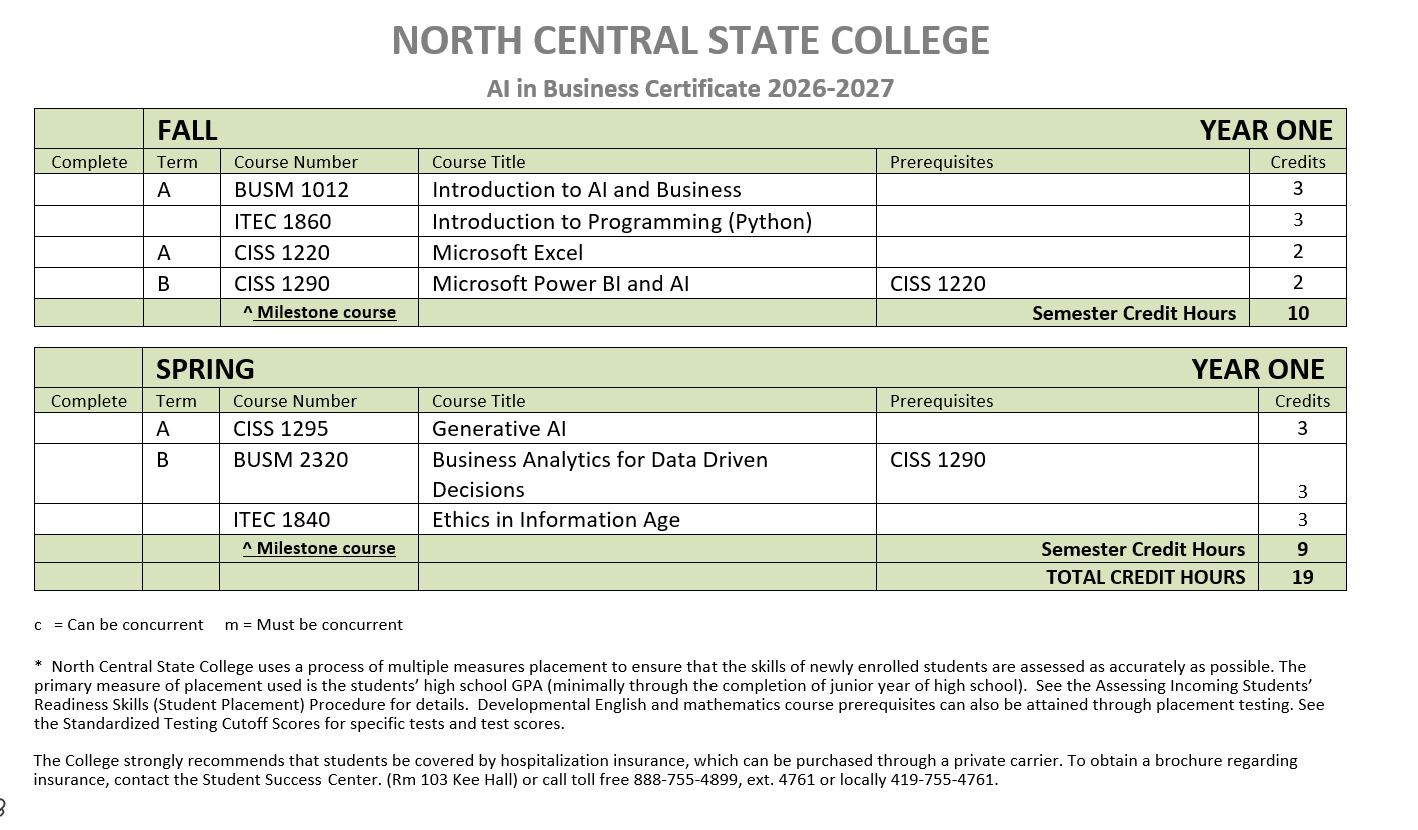
Request Information, opens in a new windowFall Semester
Courses
BUSM 1012 - Introduction to AI and Business
In this course the student is exposed to a broad view of the business enterprise and how each category of business can ethically use artificial intelligence (AI) as a tool. The student will gain insight into the necessity and mutual interdependence of such key business functions as management, human resources, operations and quality, marketing, accounting, and finance. Additionally, the topics of economics and information systems are introduced. Throughout this course the student will gain extensive experience with a direct application of AI use, its benefits, limitations, and ethical considerations, within each topic-area covered in business. The student will also gain experience in problem-solving by means of applying basic business math skills to typical business scenarios.
CISS 1220 - Microsoft Excel
This course is an introductory course in spreadsheets using Microsoft Excel for Windows. Through a series of hands-on exercises, the student will create, edit, format, and print worksheets. Topics include: creating, saving, retrieving, formatting, editing, printing, creating formulas, using functions, naming cells and ranges, creating tables, creating charts, defining range names, validating data, sorting and filtering data, maintaining file organization, and using templates.Â
CISS 1290 - Microsoft Power BI and AI
This course introduces the concepts and application of data analytics in business. A hands-on approach using Microsoft Excel, Power BI, and artificial intelligence (AI) tools is employed for data analysis, data visualization, modeling, and creating dashboards with direct connectivity to data sources. Students will explore how AI enhances business intelligence through predictive insights and automation within analytics workflows.
ITEC 1860 - Introduction to Programming
Python is a user-friendly, object-oriented programming language. This course provides a clear, accessible, and skill-focused approach to programming with Python using Python 3. The course offers students a thorough overview of multiple applied areas, including image processing, cryptography, astronomy, the Internet, and bioinformatics. Problem sets are based on real-world examples and problem-solving rather than language features. This course offers students a solid platform of key problem-solving skills that translate easily across programming languages.
Spring Semester
Courses
BUSM 2320 - Business Analytics for Data Driven Decisions
An understanding of data is fundamental to success in the digital age of business. This course provides the theoretical foundation of data analytics as well as the application of data analysis tools. Students will develop competencies to structure data and use data mining techniques in response to business scenario queries. Students will experience how businesses rely on data analysis every day to make relevant, data-driven decisions. Through projects and simulations, this course enables students to apply their technical skillsets to real-world business situations
CISS 1295 - Generative AI
This course introduces students to generative artificial intelligence technologies and their applications in business analytics. Students will explore tools such as ChatGPT, Microsoft Copilot, and other AI platforms to create content, automate workflows, and generate predictive insights. Emphasis is placed on ethical use, prompt engineering, and integrating generative AI into data analysis and visualization processes.
ITEC 1840 - Ethics in Information Age
This course provides a strong understanding of the legal, ethical, and societal implications of information technology. Updated to cover the latest technological developments, this edition examines issues associated with the professional code of ethics, cyberattacks and cybersecurity, security risk assessment, privacy, electronic surveillance, freedom of expression, censorship, protection and infringement of intellectual property, development of high-quality software systems, the impact of IT on society, social networking, and the ethics of IT corporations.